
Inside Crypto Casino Security: Cold Storage, Multi-Signature Architecture, and Smart Contract Audits
The rapid evolution of decentralized iGaming has provided players with unparalleled speed, global accessibility, and unprecedented anonymity. However, the shifting nature of digital assets introduces unique operational risks. Unlike traditional online gambling platforms that rely on centralized banking rails, cryptocurrency platforms manage irrevocable, permanent blockchain transactions. When a digital asset moves, it cannot be recalled. This foundational reality makes data security and asset management the absolute bedrock of a trustworthy gaming environment.
For players navigating this space, particularly within highly regulated and forward-looking digital hubs like the United Arab Emirates (UAE), separating marketing claims from actual security infrastructure can be challenging. Many platforms promise absolute safety, yet the decentralized ledger tells a more nuanced story. True security does not exist in a vacuum, nor is it ever static. It requires a layered matrix of cryptographic defenses, multi-key authorization protocols, and continuous independent code verification.
Our platform operates as an independent educational resource and research repository. We do not host games, nor do we act as a promotional directory for operators. Instead, our mission is to peel back the consumer-facing interface of the industry’s leading crypto casinos, analyzing exactly how they manage player funds, maintain institutional-grade liquidity, and protect automated blockchain transactions. Through exhaustive, criteria-driven security reviews, we empower players to look past superficial promotional bonuses and evaluate platforms on their genuine technical merits.
Cold Storage Implementation
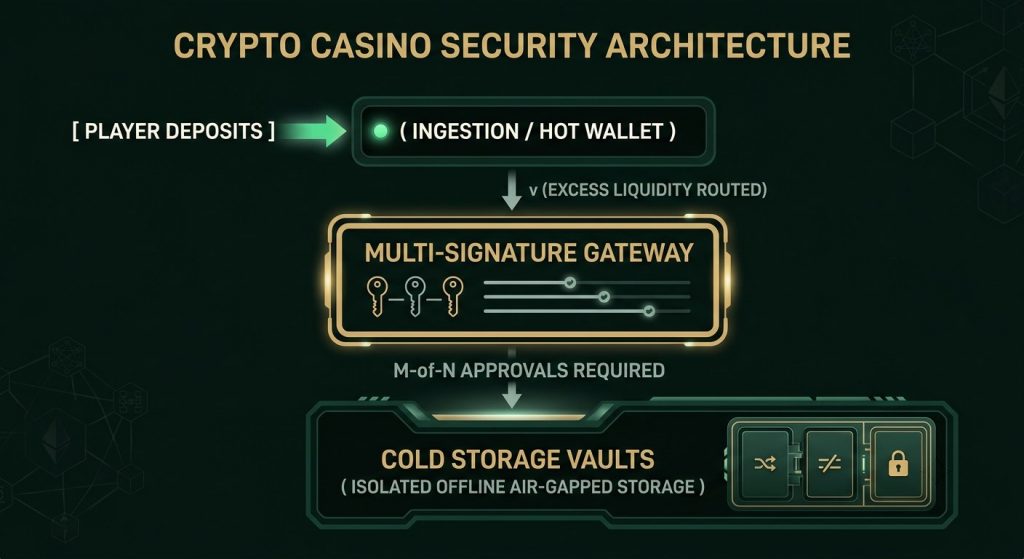
The absolute cornerstone of asset preservation is the strict separation of operational capital from historical player reserves. This is achieved through cold storage implementation. Cold storage refers to keeping cryptocurrency private keys entirely disconnected from the internet. When keys are kept on internet-facing systems, known as hot wallets, they are inherently vulnerable to malicious network intrusions, remote code execution, and phishing campaigns.
In our structured evaluations, we analyze whether an operator limits its internet-exposed hot wallets to immediate operational liquidity—typically the capital required to cover standard daily withdrawals. The vast majority of player deposits should be swept automatically into isolated, hardware-secured offline repositories. These deep-storage vaults leverage air-gapped hardware security modules (HSMs) or specialized physical devices that require physical presence and human intervention to sign transactions. By ensuring that private keys never interact with a network-connected environment, the platform creates an impassable barrier against remote cybercriminals.
Multi-Signature Wallet Architecture
Relying on a single private key to manage institutional crypto funds introduces a catastrophic single point of failure. If an individual executive, developer, or system administrator is compromised, or if a single device is lost, the entire treasury faces immediate liquidation risks. To counter this insider threat and operational exposure, leading platforms deploy multi-signature wallet architecture, commonly known as multisig.
Multisig technology works exactly like a physical bank vault that requires multiple separate keys held by different individuals to unlock. Programmatically enforced on the blockchain, a multi-signature wallet requires an M-of-N authorization threshold to execute any outbound transaction. For example, in a 3-of-5 configuration, five distinct private keys exist, each stored on separate, geographically distributed hardware devices. Any movement of funds from the cold treasury requires the cryptographic signatures of at least three of those independent keys.
Our reviews meticulously evaluate whether an operator relies on single-signature mechanisms or if they enforce decentralized, multi-signature protocols across their primary treasuries. This multi-key requirement ensures that even if an attacker successfully breaches one system or compromises a keyholder, the overall asset pool remains completely untouched.
Smart Contract Audits and Decentralized Fairness
As the iGaming market matures, there is a distinct structural shift from hybrid platforms (which use crypto merely for payments) to fully decentralized, Web3-native platforms. On Web3 platforms, the entire operation—from player wagers and random number generation (RNG) to payout distributions—is governed by autonomous smart contracts running on public blockchains like Ethereum, Solana, or Polygon.
While smart contracts eliminate human bias and ensure programmatic execution, they introduce a different form of vulnerability: code exploits. On a public ledger, a smart contract’s code is fully visible. If that code contains logical flaws, reentrancy vulnerabilities, or overflow errors, malicious entities can drain the contract’s entire liquidity pool instantly. Because blockchain transactions are permanent and immutable, a exploited contract cannot be rolled back.
The Gold Standard of Independent Audits
To verify that a platform’s code is structurally sound, continuous smart contract audits are essential. A professional audit involves a exhaustive, line-by-line inspection of the contract code by specialized, third-party blockchain security firms such as CertiK, OpenZeppelin, SlowMist, or Hacken.
Our security reviews actively look for publicly accessible, time-stamped audit reports. When evaluating these documents, we look at several layers of the auditing lifecycle:
Smart Contract Auditing Lifecycle
The multi-stage security pipeline ensuring on-chain business logic integrity
Code Freeze
The operator halts all active code alterations. This gives the external auditing firm a definitive, unchanging snapshot of the repository to prevent “moving target” vulnerabilities.
Automated Static Analysis
Auditors utilize specialized software suites to scan the codebase for known vulnerability patterns, syntax errors, and deviations from optimization best practices.
Manual Code Review & Formal Verification
At least two independent security researchers manually inspect the business logic line by line. This process identifies complex economic exploits, oracle manipulation risks, and subtle logical dependencies. Concurrently, formal verification mathematically proves the code behaves correctly under every conceivable computational state.
Initial Findings Report
The auditing firm delivers a preliminary vulnerability ledger to the casino’s core engineering team, detailing critical exploits, logic bugs, and structural flaws.
Remediation and Fix Verification
We track whether the casino’s development team actively corrected the vulnerabilities identified during the initial review before deploying the final code to the mainnet.
Final Report Publication
An immutable, publicly accessible audit report is generated, complete with on-chain verification cryptographic hashes, verifying the platform’s protocol safety.
Provably Fair Security Mechanics
Replacing blind trust with decentralized mathematical verification
Beyond financial smart contracts, transparency extends directly into the games themselves. Traditional online casinos require players to blindly trust that an internal, closed-source Random Number Generator (RNG) is truly unbiased. Cryptocurrency casinos replace this blind trust with mathematical verification through Provably Fair security mechanics.
The provably fair algorithm utilizes cryptographic hash functions, specifically SHA-256, to ensure that neither the casino nor the player can know or manipulate the outcome of a game before it begins. The system combines three distinct elements:
Server Seed
A secret value generated by the casino’s server, which is hashed and displayed to the player before they place a bet. Because the hash is visible, the casino cannot alter the server seed mid-game without breaking the cryptographic proof.
Client Seed
A randomized string generated locally by the player’s web browser or customized manually by the player. This ensures the player injects their own entropy into the final calculation.
Nonce
A simple counter variable that increments with every individual wager placed, preventing identical outcomes across multiple game rounds and preventing pattern prediction.
Our Structured Security Evaluation Methodology
Standardized, evidence-based technical analysis across core risk domains
We believe that objective comparison requires a unified framework. Rather than evaluating platforms based on subjective user experiences or marketing statements, we subject every crypto casino to our standardized Security Evaluation Methodology. This structured process focuses heavily on evidence-based analysis, analyzing verifiable data points across several core domains.
| Evaluation Domain | Verifiable Data Points Evaluated | Core Security Objective |
|---|---|---|
| Treasury Management | Cold-to-hot wallet asset ratios, multi-signature threshold settings (e.g., 3-of-5), use of hardware security modules (HSMs). | Isolation of player capital from internet-facing networks. |
| Code Integrity | Third-party smart contract audit reports, public GitHub commit histories, bug bounty program presence. | Mitigation of smart contract vulnerabilities and exploit vectors. |
| Transaction Reliability | Historical withdrawal processing times, fee transparency, automated smart contract escrow handling. | Protection against manual withdrawal freezes or arbitrary asset withholding. |
| Regulatory Compliance | Active gaming licenses (e.g., Curaçao, Anjouan, Costa Rica), adherence to international AML/KYC frameworks. | Ensuring formal legal oversight and corporate accountability. |
| Platform Transparency | Publicly accessible wallet addresses, proof-of-reserves (PoR) protocols, real-time transaction tracking. | Elimination of fractional reserve practices or unbacked liabilities. |
Our methodology places significant weight on historical platform reputation and direct community feedback. We monitor decentralized community forums, public developer channels, and specialized security databases to track any documented technical inconsistencies, unannounced changes to wallet smart contracts, or unexplained withdrawal delays. By cross-referencing these real-world data points against the platform’s stated security protocols, we provide our readers with a balanced assessment of their ongoing operational practices.
Navigating Privacy, Liquidity, and Risk Management
Balancing friction-free operations with institutional-grade risk mitigation protocols
A high-performance crypto casino must protect more than just the digital assets inside its vaults; it must secure the entire operational ecosystem. This requires balancing advanced privacy features with robust, automated risk management procedures.
Deposit & Withdrawal Reliability
The ultimate real-world test of any gaming platform’s architecture is its ability to handle high-value withdrawals swiftly and transparently. In centralized environments, processing large payouts often requires tedious manual authorizations, multi-day bank holds, and arbitrary documentation requests.
- Hybrid Processing Architecture: Automated, smart-contract-driven rules process standard transactions instantly, eliminating internal wait times.
- Multi-Sig Checkpoints: High-value high-roller payouts are routed through offline, multi-key confirmation loops with human oversight.
- Pool Liquidity Protection: This structural approach prevents automated network exploits from draining liquid assets while ensuring stable day-to-day cashouts.
Privacy & Anonymity Features
One of the main reasons players choose blockchain-based platforms is the preservation of data privacy. Traditional platforms collect extensive personal files, exposing players to global data breaches, identity theft, and corporate leaks.
- Non-Custodial Web3 Auth: Verification of native wallet connections (e.g., MetaMask, WalletConnect) to authorize accounts without email data collection.
- Registration Auditing: Clear parsing of platforms that allow gameplay via decentralized IDs versus those enforcing legacy account sign-ups.
- Regulatory Balance: Analyzing how platforms align zero-knowledge privacy protocols with international AML requirements and Source of Funds (SoF) verifications.
Independent Research Over Marketing Claims
The modern iGaming landscape is flooded with flashy marketing banners and paid endorsements. Many affiliate directories function simply as paid advertising spaces, ranking operators based on marketing partnerships rather than technical security standards.
Our platform was founded to challenge this paradigm. We approach crypto casino reviews from a analytical, engineering-focused perspective. We do not accept sponsorship deals to alter our assessment of a platform’s backend infrastructure. If an operator fails to publish its smart contract audit results, maintains an opaque wallet structure, or hides its regulatory licensing info, our evaluations note these issues explicitly as areas of risk.
Our Foundational Policy: We do not provide financial advice, nor do we certify any platform as completely risk-free. Blockchain environments are dynamic, and new exploit vectors can appear at any time. Our goal is to provide deep technical transparency so you can compare platform architectures objectively and select platforms that meet institutional security standards.