
The intersection of cryptocurrency and online gaming has transformed the international digital entertainment market. In the United Arab Emirates (UAE), where smartphone penetration exceeds 96% and the local population is highly tech-savvy, interest in decentralized gaming platforms has surged. However, because the UAE historically maintained strict legal prohibitions against all forms of wagering, residents, expatriates, and international operators frequently find themselves confused about what is legally permissible.
The regulatory environment is undergoing its most significant structural shift in decades. With the establishment of the General Commercial Gaming Regulatory Authority (GCGRA) and groundbreaking amendments to federal laws, the UAE is transitioning from an outright ban to a highly sophisticated, federal-level controlled environment.
This comprehensive guide breaks down the legal realities of using digital currencies for gaming, how the GCGRA operates, and what security measures are required to guarantee player safety and financial compliance.
What is Crypto Gambling?
The evolution of online gaming through decentralized technologies
Crypto gambling refers to any online gaming, betting, or lottery activity where players use digital currencies instead of traditional fiat money (such as UAE Dirhams or US Dollars) to fund accounts, place wagers, and withdraw winnings.
Core Models of the Ecosystem
Crypto Casinos
Online platforms that allow players to play traditional casino games—such as slots, blackjack, roulette, and baccarat—using cryptocurrencies like Bitcoin (BTC), Ethereum (ETH), and Tether (USDT).
Blockchain Gaming
Decentralized applications (dApps) built directly on blockchain networks. These games often utilize smart contracts to execute wagers and distribute payouts automatically, removing the traditional casino middleman.
Provably Fair Gambling
A cryptographic technology unique to blockchain platforms. It allows players to manually verify the randomness and integrity of every spin or card deal, ensuring the operator has not manipulated the outcomes.
Crypto Sports Betting
Sportsbooks that accept digital assets for wagering on global sports events and esports. They offer instant bet settlements and dynamic odds powered by decentralized data feeds (oracles).
Decentralized Payments
The practice of using non-custodial crypto wallets to bypass traditional banking networks, offering faster processing speeds and reduced transaction fees.
Hybrid Casinos
Platforms that bridge the gap between Web2 and Web3, allowing players to use both traditional fiat methods (like credit cards) and crypto assets, providing a flexible entry point for beginners.
Is Crypto Gambling Legal in the UAE?
To understand the current legal status of crypto gaming, it is necessary to separate offshore operations from the newly established domestic regulatory framework.
Historically, the UAE Penal Code (Federal Decree-Law No. 31 of 2021) and the Cyber Crimes Law (Federal Decree-Law No. 34 of 2021) strictly criminalized the operation, promotion, and participation in gambling activities. Online platforms were systematically blocked by local telecommunications authorities, and processing gambling-related financial transactions through local banks was impossible.
The launch of the GCGRA changed this dynamic entirely. The UAE does not allow unregulated, wild west crypto operations. Instead, the country is building a perimeter where only explicitly licensed operators can legally offer internet gaming and sports wagering services.
Under this framework, an activity is considered lawful only if it is conducted through an entity that has successfully obtained a commercial gaming license from the GCGRA. Participating in or facilitating gambling on unlicensed, offshore crypto platforms remains illegal and exposes both operators and users to severe legal and financial risks under the Cyber Crimes Law.
Understanding the GCGRA Framework
The Federal Legal Infrastructure for Commercial Gaming in the UAE
The General Commercial Gaming Regulatory Authority (GCGRA) serves as the sole federal executive body authorized to regulate, license, and supervise all commercial gaming activities across the seven Emirates.
A historic turning point occurred when Federal Decree-Law No. 25 of 2025 took effect. This law completely excised Articles 1012 through 1021 from the old UAE Civil Transactions Law (Civil Code). For decades, these civil code provisions treated all wagering contracts as inherently void and complicated financial recovery claims. By removing them entirely, the UAE government cleared away any legal ambiguity or regulatory duplication.
The repeal of the old civil code gambling provisions means that general civil transactions follow universal rules, while all gaming and wagering contracts are now governed strictly by specialized GCGRA regulations and licenses. This provides the institutional predictability required for secure commercial operations.
Four Primary Operational Streams
Lotteries
National scale prize draws and lottery products managed under strict federal oversight.
Internet Gaming (iGaming)
Virtual casino games, slots, and interactive chance-based platforms tailored for the digital ecosystem.
Sports Wagering
Regulated sportsbooks and event betting operating within defined compliance frameworks.
Land-Based Casinos
Integrated luxury resorts featuring physical gaming floors, such as the approved Wynn Al Marjan Island development.
The authority enforces an uncompromising suitability assessment process. Any operator wishing to offer digital asset gaming options must prove their corporate integrity, show massive financial reserves, implement advanced geo-fencing to block prohibited audiences, and submit their software to rigorous technical audits.
Crypto-to-Fiat Gateways
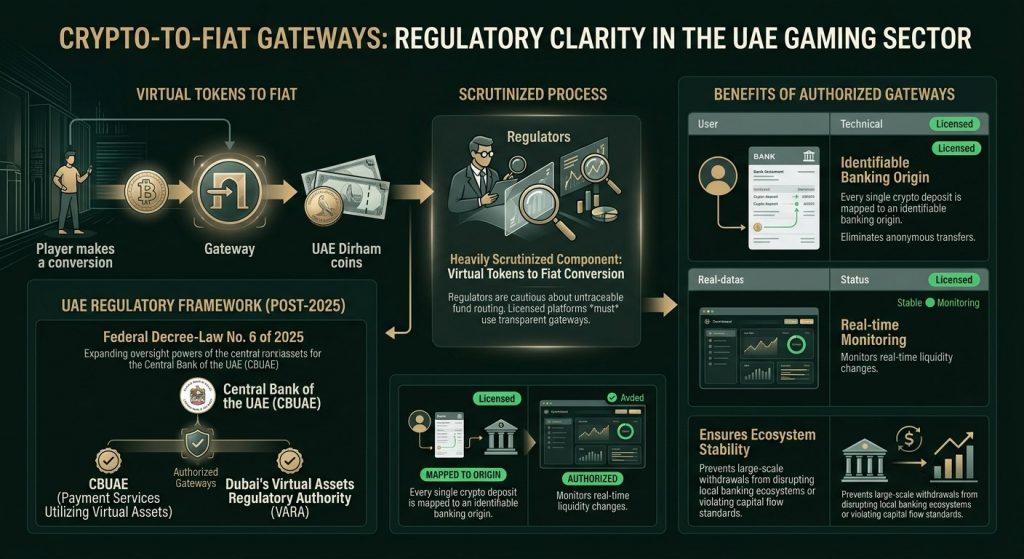
One of the most heavily scrutinized components of digital asset gaming is the mechanism used to convert virtual tokens into fiat currency. Regulators are naturally cautious about untraceable fund routing. Therefore, any licensed platform incorporating crypto options must utilize transparent crypto-to-fiat gateways.
In late 2025, the UAE issued Federal Decree-Law No. 6 of 2025, which expanded the oversight powers of the Central Bank of the UAE (CBUAE) to explicitly include payment services utilizing virtual assets. This means that any gateway processing crypto deposits or converting crypto to UAE Dirhams must be authorized by both the Central Bank and local digital asset bodies like Dubai’s Virtual Assets Regulatory Authority (VARA).
These authorized gateways ensure that every single crypto deposit can be mapped to an identifiable banking origin. This eliminates anonymous transfers, monitors real-time liquidity changes, and ensures that large-scale withdrawals do not disrupt local banking ecosystems or violate capital flow standards.
KYC Requirements for Player Verification
Mandatory compliance protocols within the UAE’s regulated gaming environment
Anonymity is completely incompatible with the UAE’s regulated gaming environment. To prevent identity theft, under-age access, and financial manipulation, licensed operators must enforce an exhausting Know Your Customer (KYC) protocol.
When a user opens an account on a compliant platform, they must progress through several mandatory verification tiers:
Identity Verification
Tier 1 ComplianceThe player must submit a valid, high-resolution color copy of their Emirates ID or international passport. Many operators utilize biometric facial scanning apps to cross-check live selfies against the submitted government documentation.
Proof of Residential Address
Tier 2 ComplianceTo ensure correct regional tax compliance and valid geo-location, users must upload a recent utility bill, internet bill, or official local bank statement issued within the last three months clearly showing their registered name and address.
Source of Funds (SoF) Declaration
Tier 3 ComplianceFor high-volume transactions or premium accounts, players must legally declare and prove where their digital assets originated. This involves providing salary slips, proof of corporate dividends, or documented crypto trading history from a licensed local virtual asset service provider (VASP).
AML & Anti-Fraud Measures
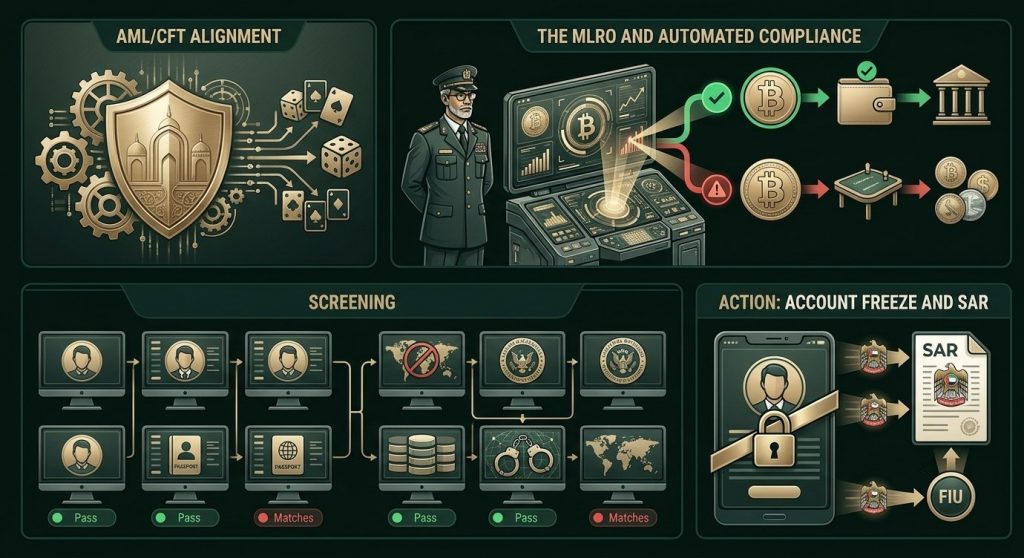
The United Arab Emirates maintains an aggressive stance on anti-money laundering (AML) and counter-terrorism financing (CFT), overseen strictly by the Executive Office for AML/CFT. The GCGRA framework aligns directly with these national initiatives to ensure the gaming sector cannot be used as a conduit for illicit wealth.
Licensed operators are legally mandated to appoint a resident Money Laundering Reporting Officer (MLRO). The MLRO is directly responsible for overseeing transaction monitoring programs that run continuously. These automated compliance algorithms look for suspicious behavioral patterns, such as a user depositing large amounts of Bitcoin, performing minimal gaming activity, and immediately requesting a withdrawal in a different token or fiat currency.
Furthermore, platforms must run all user information against international sanctions lists, politically exposed persons (PEP) databases, and global financial crime watchlists. Any match or highly suspicious transaction pattern requires the operator to immediately freeze the account and submit a Suspicious Activity Report (SAR) to the UAE Financial Intelligence Unit (FIU).
Player Asset Segregation
Financial Stability and Consumer Asset Protection in the UAE
Financial stability is a cornerstone of E-E-A-T principles within commercial gaming. To protect consumers from corporate malpractice or market collapses, the GCGRA requires absolute player asset segregation.
Under this rule, operator funding and player balances must be held in entirely separate legal structures:
| Financial Indicator | Operator Operational Account | Player Balance Trust Account |
|---|---|---|
| Permitted Funds | Corporate revenues, venture capital, licensing fees. | Direct player deposits, active stakes, uncontested winnings. |
| Usage Restrictions | Used for marketing, local salaries, software licensing, and expansion. | Strictly locked; cannot be touched by management for any corporate expense. |
| Insolvency Status | Fully exposed to liquidators and corporate creditors during bankruptcy. | Protected completely; legally insulated and returned directly to users. |
| Banking Location | Approved UAE corporate commercial banking institutions. | Ring-fenced trust accounts monitored by the Central Bank of the UAE. |
Core Components of Player Safety
Technical and Behavioral Protections Within a Regulated Ecosystem
True player safety involves much more than just protecting account balances. A highly regulated market enforces an ecosystem of technical and behavioral protections designed to mitigate the inherent social risks of gaming.
Data Encryption & Cyber Defense
All platform communication, financial records, and private KYC data must be guarded by military-grade transport layer security (TLS) and end-to-end encryption. Platforms undergo mandatory, third-party penetration testing to guarantee their systems can repel advanced cyberattacks and prevent data leaks.
Comprehensive Responsible Gambling Tools
The GCGRA mandates that social responsibility controls be built directly into the user interface. Players must have instant access to tools allowing them to configure custom deposit limits, loss caps, and session time reminders.
Centralized Self-Exclusion Registers
If a player feels they are developing an unhealthy relationship with gaming, they can opt into a definitive self-exclusion program. This restriction blocks their profile across all licensed operators uniformly throughout the UAE. Compliance algorithms continuously monitor and prevent self-excluded individuals from creating alternative accounts.
Independent Dispute Resolution
Unlike offshore sites where users have no legal recourse if an operator refuses to pay, GCGRA-licensed platforms operate under enforceable local law. If a software glitch occurs or a payout is unfairly withheld, players can file an official administrative appeal directly with the regulatory authority for a binding, transparent legal resolution.
The Dangerous Reality of Offshore Crypto Casinos
The severe operational and legal threats of bypassing domestic regulations
Because the domestic regulated market is tightly controlled, many users are tempted to use Virtual Private Networks (VPNs) to access unregulated, offshore crypto casinos operating out of remote jurisdictions. While these platforms often advertise massive bonuses and completely anonymous registration, they carry severe operational and legal threats.
Legal Risks
Violation of Cyber Crimes Law penalties and potential prosecution for bypassing local digital safety frameworks.
Financial Risks
Arbitrary asset freezes, sudden account closures, and zero legal recourse to recover your digital assets.
Operational Risks
Software can be effortlessly rigged with unfair payout logic and falsified Random Number Generators.
Offshore sites operate entirely outside the jurisdiction of UAE courts and the GCGRA. If an offshore operator chooses to close your account, wipe out your Bitcoin balance under the guise of a terms-of-service violation, or alter their payout algorithm, you have absolutely zero legal recourse.
Furthermore, using unauthorized platforms violates local digital safety laws, exposing individuals to potential bank account closures by local financial institutions vigilant against unmapped virtual asset movements.
The Benefits of Using Regulated Operators
Transforming the digital gaming experience into a secure, predictable environment
Choosing to interact solely with GCGRA-authorized and licensed platforms transforms the digital gaming experience from an unstable gamble into a secure, fully transparent ecosystem.
Verified Software Authenticity
Every slot game, virtual card dealer, and sportsbook matrix on a regulated site must be certified by an accredited international testing laboratory. This ensures that the Random Number Generators (RNG) are honest and match the advertised return-to-player (RTP) percentages.
Guaranteed Financial Accountability
Because player funds are legally ring-fenced and backed by transparent local capital, valid withdrawals are processed instantly without arbitrary delays or hidden conversion deductions.
True Legal Protection
Every bet placed is a legally recognized, binding contract protected by UAE federal regulations. This provides peace of mind that cannot be replicated by any unregulated alternative.
Ad Network Cleanliness
Following the major Google Ads policy updates implemented in March 2026, only GCGRA-certified entities are permitted to advertise internet gaming and sports wagering services within the UAE. This structural step actively helps consumers identify legitimate platforms.
The Future of Crypto Gambling in the UAE
Deliberate, progressive alignment between gaming frameworks and advanced fintech
The future of digital asset gaming within the Emirates lies in deliberate, progressive alignment between gaming frameworks and advanced financial technology. The UAE has no intention of permitting chaotic, anonymous betting markets. Instead, the country is focusing on highly trackable blockchain infrastructures.
We expect to see deepening institutional cooperation between the GCGRA and regional digital asset pioneers like Dubai’s VARA and Abu Dhabi’s Global Market (ADGM) Financial Services Regulatory Authority. This collaboration will likely manifest in the deployment of state-backed stablecoins (such as regulated AED-pegged tokens) within licensed gaming platforms to provide immediate settlement times without the volatility associated with standard utility tokens.